Nadia, your AI agent, runs every interview, then turns them all into insights you can act on.

Questions, follow-ups, and answers in their own words.
Interviews conducted in your own voice and style.
Nothing to build and nothing to tag.
No downloads. Any number of participants.
A form reaches everyone but never asks why. A call gets to the reason, but only a few fit into your week. Nadia, the Pulse agent, has a real conversation with every participant, then turns all of them into insights.
A number. No reason.
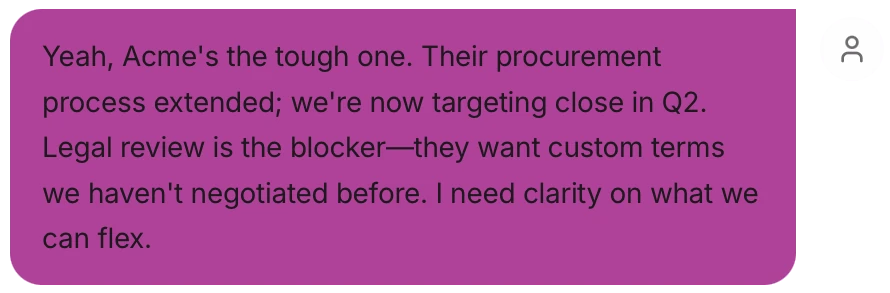
Legal review is the blocker. They want custom terms we haven’t negotiated before.
One rep, one call
A reason. From one person.
Legal review is the blocker.
The number, and the reasons, from everyone.
Nadia is the agent who runs your interviews, unless you’re using a Digital Twin. She reads across every one of them. Ask her a question and she answers, then goes into the dashboard to show you where the answer came from.
Structured questions, open topics, or a ready-made template. Turn on follow-ups for more depth.
Any number of participants. Each gets their own one-to-one session, at their own pace.
She asks, listens, follows up, and adapts as the conversation goes.
Per-interview results as each one finishes. Findings, themes, and trends across everyone.
Turn on a Digital Twin and the interview is conducted in your own voice and style. Participants see and hear your Digital Twin instead of Nadia. You still get the insights from every conversation, with its transcript and summary.
Turn it on for any interview. Your likeness and voice remain yours.
For the people you interview, it’s a conversation. Not a form.
No downloads and nothing to schedule.
Each person joins at their own pace.
A conversation, not a rating scale.
In Pulse, only the admin who set up the interview can see the responses.
No video or audio is saved. Pulse keeps the transcript, and nothing more.
Limit an interview to the people you need by adding their email addresses.
Turn on follow-up questions and every main question gets sub-questions that drill deeper.
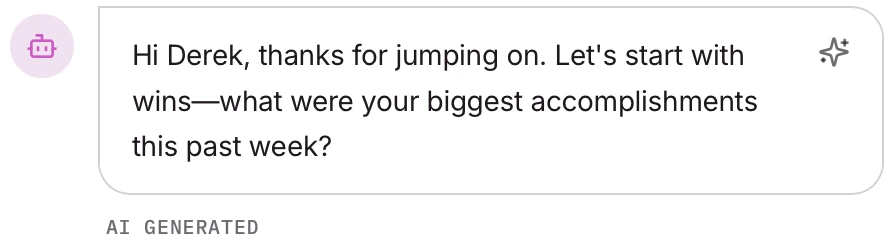
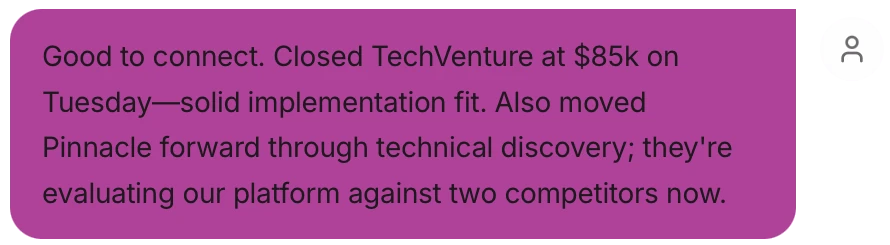
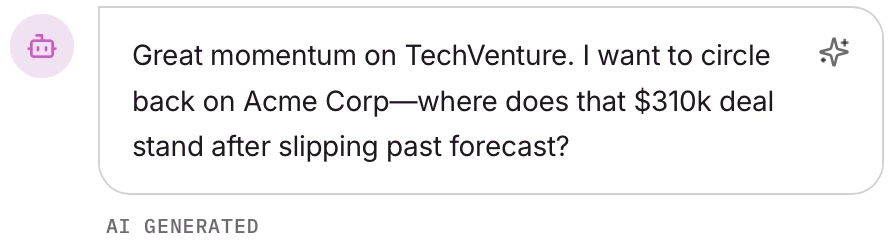
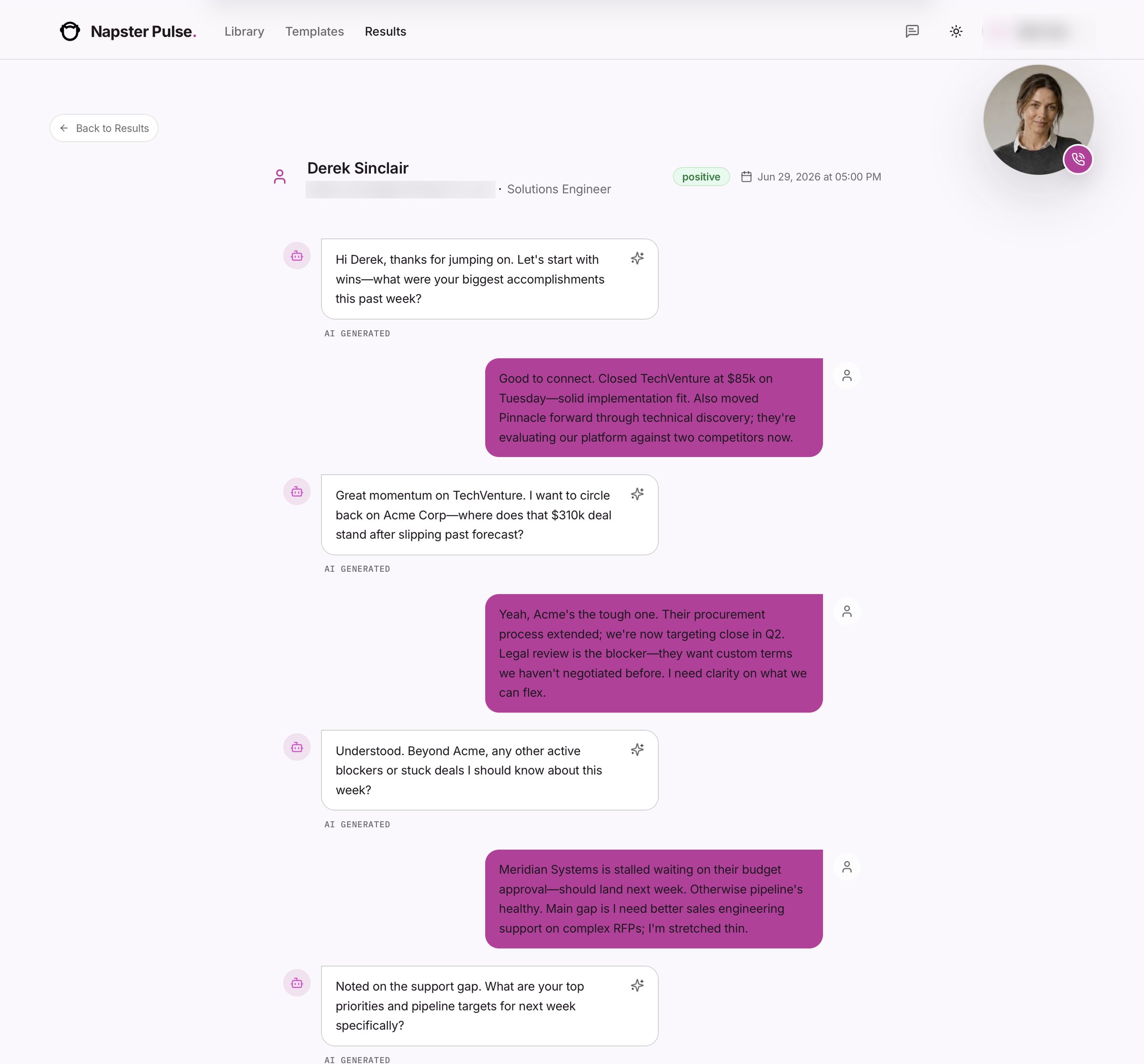
Every interview feeds one dashboard, with seven views from the executive summary to key findings.
Wherever you need to hear from more people than you could ever call.
What moved, what is blocked, and how confident they are in the forecast.
Decision criteria, price perception, and the competitor chosen.
What moved, what is blocked, and what people need from each other.
Each responder describes their own timeline and what they were missing at the time.
Every team member walks through the sprint in their own words, on their own time.
How the audience you are targeting reads a new message, in their own words.
What people remembered and what confused them, while the session is still fresh.
What happened and what the customer expected instead.
Stakeholder priorities in their own words, ahead of the meeting.
Where people got stuck and what they had to guess.
Each leaver’s account in full, plus the reasons that repeat across them.
What is clear, and what people are still missing.
What would make them bring you into a deal, and what they need ready.
Which parts of the story they can repeat and where they would hesitate.
How each department head describes the priorities and their own team’s contribution.
Each leader’s main risk and main request, in their own words.
Fifteen categories, from customer research and sales to product, strategy, HR, and hiring. Use one as it is, edit it, or start from scratch.
Understand problems, workflows, and unmet needs.
Assess budget, authority, need, and timeline.
Evaluate the effectiveness of a brand awareness campaign and identify optimization opportunities.
Evaluate and prioritize feature requests to maximize product impact with limited resources.
Facilitate quarterly or annual strategic planning to align team priorities with business objectives.
Reflect on what worked, what did not, and what to try next.
Evaluate a proposed or existing architectural decision.
Prepare for and practice fundraising conversations.
Deep-dive conversation for audio and video content.
Structured coaching conversation for personal or professional growth.
Capture a comprehensive personal narrative.
Structured year-end assessment of achievements and growth.
Understand reasons for departure and gather honest feedback.
A structured check-in with the CHRO covering hiring velocity against plan and attrition risks.
Assess past behavior as predictor of future performance.
The same 50 conversations, two ways.
of your time on calls
None of your time on calls